Market insights that speak like humans, not textbooks.

Daily clarity on global markets, macro, crypto— without the jargon.

Mi Shorts -

Today’s Fastest Insights
Two-panel chart titled “S&P 500: Record Highs, Record Dispersion.” Top panel (green) shows S&P 500 % distance from all-time high, staying near 0% (within a few percent) for long stretches. Bottom panel (red) shows % of S&P 500 constituents in a >20% drawdown, with a dashed reference line near 45% and the series hovering around/above that level. Timeline runs roughly 2006–2026. “© Bluekurtic Market Insights” logo at bottom.

Record Highs, Record Dispersion

Bull market since 2023 is unusual. Over 45% of S&P 500 stocks are in a technical bear market (20% below ATH), yet SPY sits within 3% of its own ATH. Breadth never fully reclaimed the 2021 peak, when fewer than 25% of stocks were in bear markets. Dispersion remains extreme.

The Energy Reset: Renewables Surpass Fossil Investments for the First Time

A structural reallocation is underway as global energy investments tilt decisively toward solar, wind, and storage. For markets, this signals new long-term winners

A New Power Map: Trade Blocs Are Redrawing Global Capital Flows

n the post-pandemic era and amid escalating geopolitical tension, the world’s economic landscape is undergoing a fundamental transformation. Traditional patterns of global capital movement — once governed by broad, multilateral systems and the inexorable logic of comparative advantage — are being reshaped by the rise of regional alliances and strategic trade blocs. These developments are changing not just where money flows, but why it flows there, with profound implications for investors, policymakers and ordinary citizens alike.

The Rise of Regionalism in a Fragmented Global Order

Global trade used to be dominated by a relatively unified framework of rules centred on institutions like the WTO. Today, that framework is under strain. Rising tariffs, protectionist measures and geopolitical friction have increased the appeal of regional strategies that protect domestic industries and strengthen economic resilience. State Street

Across continents, trade blocs such as the European Union (EU), USMCA (United States-Mexico-Canada Agreement), CPTPP (Comprehensive and Progressive Agreement for Trans-Pacific Partnership), ASEAN and AfCFTA (African Continental Free Trade Area) are not just facilitating tariff-free commerce — they’re reshaping the global financial environment by creating integrated markets where capital and investment can circulate more freely within the bloc. World Economic Forum

These agreements lower regulatory barriers, align standards and often include provisions for investment protection. As such, they encourage capital to flow internally — from one member country to another — creating concentrated corridors of financial activity that can outshine traditional North-South or East-West channels.

Why Trade Blocs Matter for Capital Flows

1. Regional Investment Patterns and Strategic Alignment

Capital flows increasingly reflect political alignment as much as economic rationale. Countries within a trade bloc often adopt shared regulatory frameworks and strategic priorities, which can hasten cross-border investment in infrastructure, high-tech sectors and financial services. Medium

For instance, within the Asia-Pacific, regional agreements and integration efforts have made this zone a hub for digital infrastructure, advanced manufacturing and innovation ecosystems — attracting capital from both within and outside the region. Medium

2. Geopolitical Tensions and Investment Diversification

Escalating trade tensions — such as tariff escalations between major powers — are accelerating capital’s exit from politically risky relationships. Investors and firms are recalibrating portfolios to align with blocs perceived as stable and growth-oriented, even if that means foregoing the efficiency of broader global integration. State Street

A fragmented world economy also means that capital flows increasingly follow geopolitical lines rather than purely economic ones. In simple terms: nations trading and cooperating together tend to invest together too. State Street

3. Cross-Border Financing and New Financial Hubs

Beyond trade in goods, the real power of these blocs lies in capital markets. By harmonising rules on investment and financial services, blocs are making it easier for companies to issue debt, raise equity and access financing within the region.

This trend raises the prospect of new financial centres emerging within blocs — centres that could rival traditional hubs in London, New York or Hong Kong for regional capital. These centres can attract multinational firms, regional banks and sovereign wealth funds looking to tap deeper, more integrated markets. EconStor

The Global South’s Growing Role

One of the most striking developments is the rise of the Global South as an engine of regional trade and investment growth. Economies in Asia, Latin America and parts of the Middle East are increasingly forming partnerships that tilt the economic axis away from traditional Western dominance. BCG Global

Growth in South-South trade and investment is attracting capital not as an alternative to Western markets, but as a powerful complement. African and Latin American nations, for example, are leveraging regional corridors and trade agreements to attract foreign direct investment (FDI) and pursue infrastructure projects — often financed through regional funds or bloc-level institutions. Bloomberg.com

Challenges Amid Opportunity

Despite these opportunities, the shift toward trade blocs isn’t without challenges:

  • Fragmentation Risks: Increased regionalism may fragment the global financial system, reducing cross-border capital flows between blocs and raising borrowing costs in less integrated regions. State Street

  • Uneven Development: Smaller economies risk being sidelined if they are not part of powerful blocs or lack the infrastructure to attract capital.

  • Policy Uncertainty: Frequent shifts in trade and tariff policy can unsettle investors, prompting hesitancy or short-term capital flight rather than long-term investment.

Looking Ahead

The rise of trade blocs and regional economic alliances represents a tectonic shift in the way capital flows around the world. What was once primarily driven by comparative economic advantage is now increasingly shaped by geopolitical strategy, collective economic agendas and regional integration.

As we move further into a multipolar economic era, investors, policymakers and global businesses will need to navigate this new power map with agility and foresight. Understanding how trade blocs influence capital flows won’t just be a matter of academic interest — it will be essential for success in the global economy of tomorrow.

Mi Words -

Where clarity meets depth.

Markets Brace for Slower Earnings Growth as Profits Come Under Pressure

Corporate margins are tightening from higher input costs and moderating pricing power. Analysts warn that equity markets may face valuation headwinds through 2026 as earnings upgrades become less frequent.

Trade Winds Shift: Global Supply Chains Enter a New Phase of

With geopolitical tensions rising and onshoring trends strengthening, multinationals are restructuring supply networks across Asia and Europe. The recalibration is reshaping costs, competitiveness, and long-term trade flows.

Central Banks Near the End of the Rate Cycle—But Cuts May Come Late

Despite easing inflation, policymakers remain cautious as core price pressures stay sticky. Markets are pricing fewer cuts for 2026, reflecting concerns that premature easing could destabilize fragile economic

Consumers Are Pulling Back: The Early Signs of Demand Fatigue

Retail spending across major economies is losing momentum as households face higher borrowing costs and wage growth that’s beginning to plateau. The shift signals a cooling consumption cycle that could weigh on GDP through early 2026.

Mi Flash -

The fastest way to know what just changed.

Subscribe 

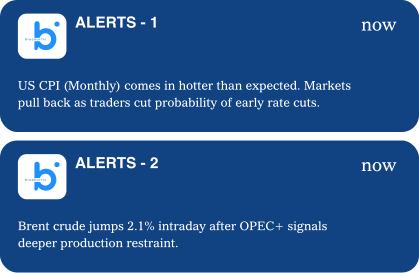
Live micro-alerts on sudden market movements, surprise announcements, and high-volatility events — updated in real time.

Upgrade to access rapid alerts.

Mi Clips -

Markets move fast. We help you keep pace.

Subscribe

Mi Dashboard -

Your markets, distilled into a single screen.

Subscribe

Indices, trends, commodities, crypto, flows all organised into clean, intuitive widgets built for quick decision-making.

Unlock full dashboard access for $50/month.

Why BlueKurtic?

We simplify markets. We remove the noise. We write to inform, not confuse.

Our approach is built on three principles:

No jargon. Insights should speak like humans.

No clutter. Design that respects your attention.

No manipulation. Just clear, honest market context.

View Pricing